
A few days ago, a friend linked me to a contest that her daughter’s art was entered in, where voting is done online. I’m sure we’ve seen this for a wide variety of things in our lives these days, so it is easy to miss some of the little details that render the competitions unfair. The original ones often had no mechanism to stop you from just clicking ‘Vote’ over and over. Then they added cookies, which are client-side, meaning you could clear cookies and vote again. After that we saw IP-based restrictions so only one vote per “computer” to the implementing parties. But VPNs and crowd-sourcing got around that as you could post it to social media for friends and family to see.
So I receive the link, like her art and go to vote. This time, it requires a Facebook account which already restricts the voting in a different way. While it is easy to assume everyone has an account these days, that isn’t true. Or if they do, they may not be willing to use it because they don’t approve of Mark Zuckerberg and his actions. [1] [2] [3] [4] [5]
So back to the vote… cool, no problem! If you want to do a good deed and have a Facebook account, you can click and vote once here. But please do not vote by paying without considering the bigger picture. First and foremost, it absolutely ruins the whole idea of a community voting for their favorite art. With this, parents that are more well off than others can simply buy enough votes to secure a win for their child. That isn’t fair to the artists. It means the winner is based on money, not talent. This kind of system can truly ruin the future of a budding artist. If they don’t win or place high, it could crush their morale giving them self doubt; enough that they decide not to pursue art in any form.
You may read the voting bit and think “hey, the money goes to charity!” and that it justifies the money subverting what should be a more fair contest. On the surface that is easy to understand, but take a few minutes to look at the charity and what they do with the money. Even looking on CharityNavigator, you see a 99% rating and really think it is worth it. But the devil is in the details, and I don’t like their new layout and score. You have to dig to find the old way they presented information which, to me, is more informative.
Let’s start with executive compensation for a “not-for-profit” organization. In 2024, the CEO Louis Jdegennaro-end received $931,409 for his 40 hour weeks in 2023. That’s likely higher due to other forms of compensation and Charity Navigator puts the total compensation at $1,358,093. Running down the list of more executives:
| Chief Medical Officer | $600,712 |
| Chief Operating Officer | $591,651 |
| General Counsel | $543,852 |
| Chief Financial Officer | $504,481 |
| Chief DEI Officer | $471,435 |
| Chief Development Officer | $465,663 |
| Chief Advancement Officer | $461,640 |
| Chief Scientific Officer | $444,473 |
| Chief Experience Officer | $423,899 |
Those ten people took home at least $5,439,215 of the charity’s dollars in one year. To me, that is ridiculous for an organization that boldly claims “WE’RE ALL ABOUT BLOOD CANCER”. Are you though? In 2024 they also paid $4,468,458 to Meta (Facebook) for advertising and another $4,897,034 to Resource One Communications for marketing. If I was an over-paid CEO, I might reconsider that.

The numbers that can be summed up and understood very quickly are one of the primary reasons I use and donate to CharityNavigator (a 501c3 themselves). All of the money raised and spent can be broken down into three categories: Administrative, Fundraising, and Program Expenses. Administrative is basically everything required to run the non-profit, and this includes executive salaries. The lower this is, the more streamlined and efficient the non-profit is. Fundraising covers anything done to raise money, from in-person events to direct mailing and more. Program expenses are the expenditures for the actual stated cause, in this case working to fight blood cancer and help people who suffer the condition.
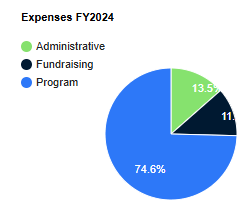
The above can be found under “Financial Metrics” on CharityNavigator. Historically, 75 – 80% program expenses was the minimum I must see to financially support a non-profit. There are exceptions where as low as 70% is acceptable to me, but typically for global organizations where expenditures around logistics are expected to be higher, like Red Cross and such. Personally I don’t think Blood Cancer United fits that bill. While they did have foreign activity, the 2024 taxes (Form 990 Schedule F Part II) are suggestive of just how that really looks, since that portion covers “Statement of Activities Outside the United States”:
| North America | Research Funding | $2,674,920 |
| Europe | Research Funding | $3,372,708 |
| Central America & Caribbean | Investments | $8,145,536 |
| Middle East & North Africa | Research Funding | $30,000 |
| East Asia & The Pacific | Research Funding | $1,995,135 |
| Europe | Investments | $8,036,661 |
Adding that up we get $8,072,763 in research funding and $16,182,197 in investments. A non-profit investing money is a good thing as it ensures financial stability and long-term security. But this is not a lot of money for Blood Cancer United in the big picture, and does not compare to the Red Cross. It also does not lend to the idea of a global presence. To put this in better context, at the end of 2024 the non-profit had the following, which are not to be added up and may require a better understanding of non-profit tax filings:
- Assets – $643,891,871
- Total Liabilities – $271,338,303
- Net Assets or Fund Balances – $372,553,568
- Total Functional Expenses – $50,579,954
- Total Revenue – $378,338,490
That is pretty incredible revenue, over 370 million dollars, and yet 51 million dollars were used for administrative purposes. Around 45 million went to fundraising and 282 million were used on program expenses. THIS IS NOT BAD, please do not get me wrong! That’s a lot of money that is going to a worthy cause. That said, this is the kind of non-profit that seems to pay executives too much in my opinion, and could do better by streamlining administrative and fundraising expenses. That’s over 25% of the money right there.
Anyway, back to the original point! Even if it is supporting a charity, just be mindful of which ones you support and how they spend their money. There are a lot of incredible charities out there, many working on shoe-string budgets and arguably doing just as much good dollar-for-dollar. But supporting charities of any kind at the expense of shattering the dreams of a young artist? Is that the best we can do as a society? I’d hope not, but here we are.

Leave a Reply