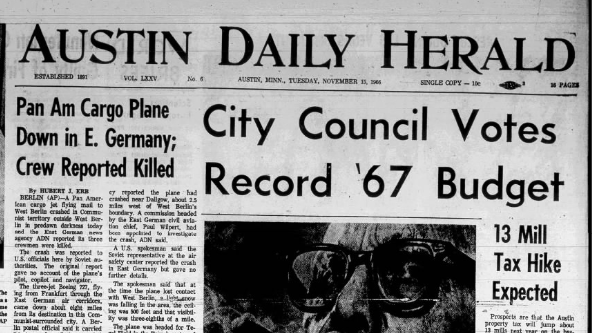
At this point I don’t even remember where I obtained a really poor resolution image of a newspaper page. It’s been on my computer for at least six years, likely much longer. Due to the poor resolution no matter how much you zoom and try to find a sweet spot of readability, the details were too fuzzy. Today, I decided to take another stab at it and try to search it out. I pinged a small group of academics, historians, sociologists, anthropologists, and security folks that collaborate on archiving and discussing ways to preserve the history of hacking and security.

Kevin Driscoll started digging immediately. Based on a few other headlines it is clear this was written during the Vietnam War putting it in the 1960s or 1970s. I had originally recognized this was a historical incident but didn’t realize it went that far back. Kevin figured out this was written in 1966 due to the Tuy Hoa headline which helped narrow it down. He was searching various newspaper archives and I began to yet again. After not much luck I was curious if any of the advertisements might help.
Berg & Bissen with that phone number was pretty easy to track down which told us this paper came from Austin, Minnesota (yes, not Texas). They are apparently still in business, now called Bissen TV & Appliance. Now with the town and state it was much easier moving forward. Thanks to newspapers.com, they have an archive of the Austin Public Library which in turn has an archive of 619,367 newspaper pages. Things were looking up!
One of the challenges with searching for old content like this based on an image is that all of these archival sites use optical character recognition (OCR). Despite advances in technology it can still have issues when the original source is lower resolution or aged. That means “typos” get introduced and searching for a name may not yield results. If the original source says “jericho” but it gets scanned in as “iericho”, then searching will not find the word. Fortunately, my search terms were good enough to find it after all this time!
From the Austin Daily Herald, Tuesday, November 15, 1966, Page 2 they had it!

Now it was much easier to read the headline in question, “Computer Technician Who Rigged Account Sentenced”. The article actually talks about several people that were convicted of various crimes but it starts out with the bit I was interested in.

Milo A. Bennett installed a computer at a bank and subsequently rigged it to ignore any overdraft, effectively allowing him to steal money. This begs the question, does it count as a “hacking” incident? One could argue that no it does not because he had privileged access, installed the computer, and configured it all while being employed by the bank. On the other hand, you might argue that yes it is hacking because while he did have privileged access, he exceeded the privileges granted to him by the bank in coding the loophole that allowed the overdraft.
I’ll leave that debate for historians, anthropologists, and sociologists. =) I’ll leave off with the full text of interest so that it will be more easily searched for in the future.
MINNEAPOLIS (AP) -- A computer technician accused of rigging his own bank account, an alleged counterfeiter and a Mankato lawyer accused of income tax evasion face U.S. District Court sentences in separate cases.Milo A. Bennett, 23, of suburban Brooklyn Park pleaded guilty Monday to making false entries in records of National City Bank, Minneapolis.Assistant U.S. Atty. Stanley Green said Bennett was hired to install a computer in the bank and rigged it to ignore overdrafts in his own checking account.A $1,357 deficit in his account was discovered after the computer broke down and records were checked by hand, authorities said.Bennet, who has returned the money, faces up to five years in prison and a $5,000 fine.
Leave a Reply