Tag: Vulnerabilities
-
Security Software: Holding the Vault Door Open for Criminals

I have been consistently tracking a fun metric around vulnerabilities since March 19, 2024. Before that I would occasionally mention it during talks or chat, but I don’t think I formally blogged about it before this and didn’t track the exact number. So here we are to discuss the prevalence of vulnerabilities in security software,…
-
Reason #42 Why InfoSec Has Failed

Building on a prior post, with an admittedly arbitrary number that seems to be about right as far as the number of reasons, and more in this series coming in the future… This is a quick story to give readers an idea of just how bad our industry really is. This is not anecdotal either,…
-
Zero Day Clock – All The Pieces Matter

Last week, a colleague shared a link to the “Zero Day Clock“, a web site that has a substantial number of signatories, including some big names. I want to talk extensively about the clock because it makes at least one significant mistake and points out what the data means along with a comparison to another…
-
Bob’s “CVE Quality-by-Design Manifesto” – The Hit and Misses
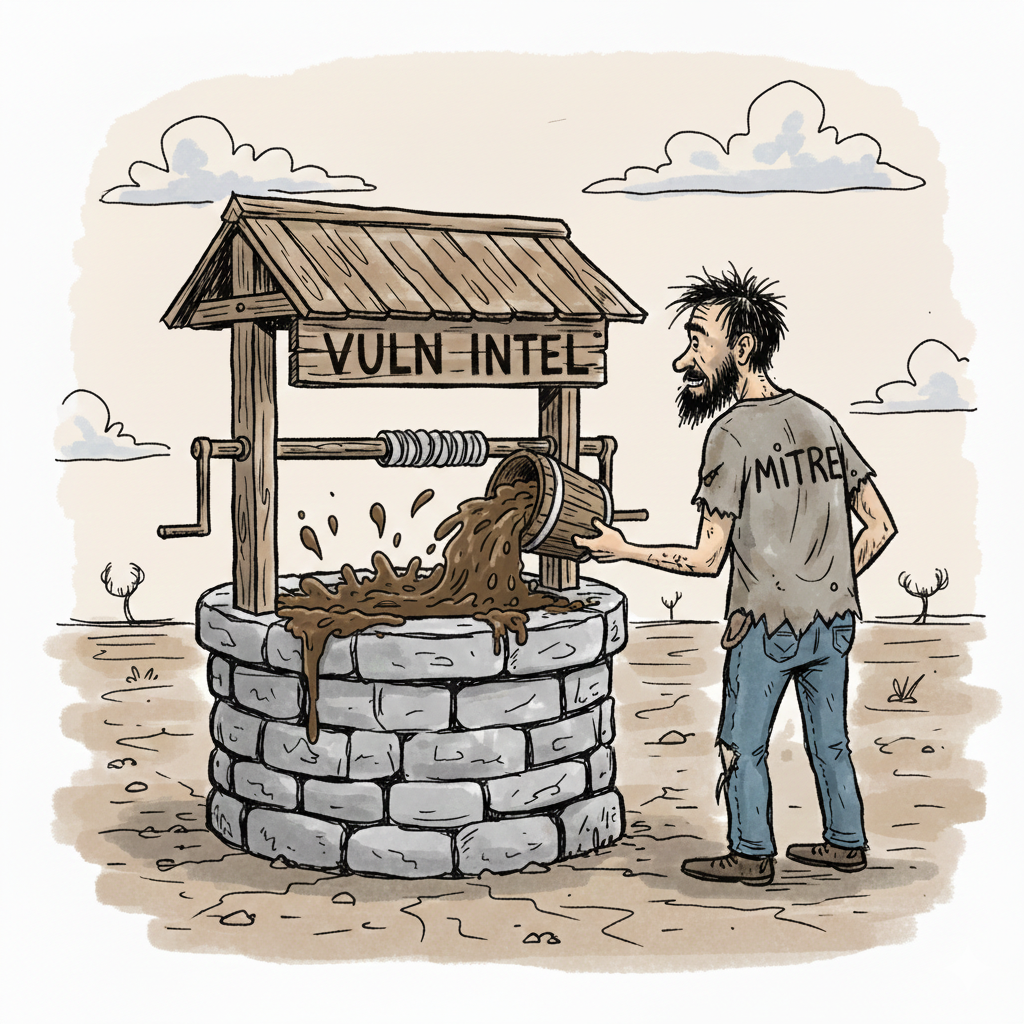
Almost every time Bob Lord blogs, I feel the need to write a rebuttal to what is arguably abject stupidity and shortsightedness. One he published a couple days ago, titled “CVE Quality-by-Design Manifesto“, is missing several core concepts in the realm of vulnerability intelligence. While his overall point is certainly valid, the order in which…
-
Vulnerability Disclosure Forensics: /cgi-bin/upload.cgi

Yesterday, Chris Sullo of Nikto fame, asked me a simple question; in so many words, what was the “first web vuln”. To be clear, he is asking about the first vulnerability in a web server / service / program. Seems relatively straight-forward but I challenge anyone to answer it with their own data set, especially…
-
Reporting on the IBM 2025 Report

On April 16, 2025, IBM posted their X-Force 2025 Threat Intelligence Index. Like many reports of this nature, it covers a wide variety of aspects relating to threat intelligence. Of course, one of those aspects is vulnerability intelligence and this report has a section for that. You are reading this so you can guess where…
-
Who Reads Mega-advisories? No one! (Almost)

Vulnerability disclosure analysts are long familiar with so-called “mega advisories”, ones that typically come from vendors and often for products that ship appliances using hundreds of libraries or products with an entire operating system included. Such advisories can literally represent over 500 vulnerabilities in one shot. I’ll try to make this a bit fun! Disclaimer:…
-
The Curious Case of CVE-2015-2551 & CVE-2019-9081 – Doom and Gloom! Or not.

What’s Your Story CVE-2015-2551? This CVE-2015-2551 entry seems straight-forward, based on the description provided by CVE or NVD. Looking at the change history on NVD it is a bit more informative: So the ID was created for the 2015 calendar year, apparently not used, rejected seven years later, and confirmed by the assigning CNA (Microsoft).…
-
Has CWE Jumped the Shark?

The Common Weakness Enumeration (CWE) is a MITRE run, community-developed list of common software and hardware weaknesses (Wikipedia Page). The project defines a “weakness” as “a condition in a software, firmware, hardware, or service component that, under certain circumstances, could contribute to the introduction of vulnerabilities.” This taxonomy has several uses but they tend to…
-
Reason #283 Why InfoSec Has Failed

For those familiar with my social media, you know that I have frequently said that our industry is failing the commons. InfoSec represents a huge market, companies get paid exorbitant amounts of money, salaries can border on the ridiculous, and the concept of researchers being famous for their work is still alive. Meanwhile, vulnerabilities are…