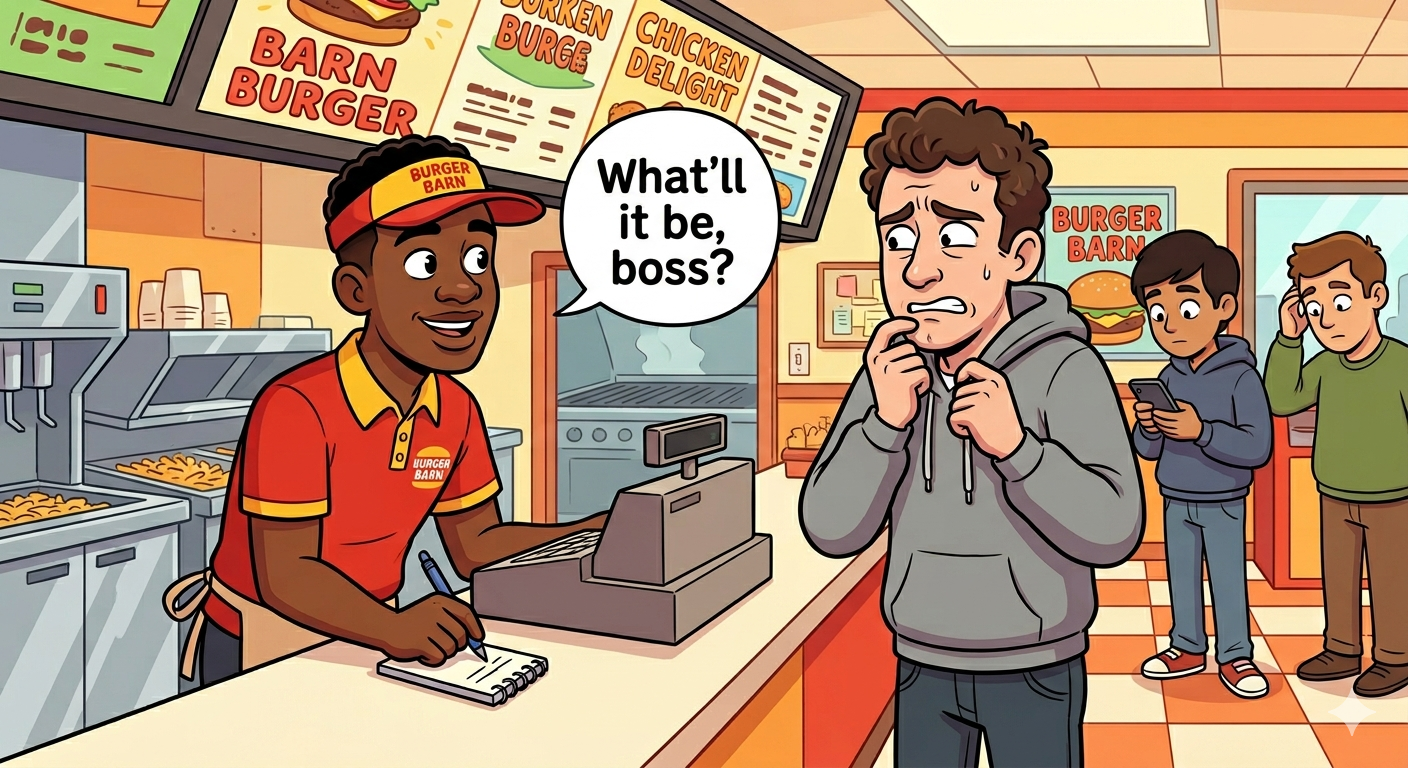
I don’t remember when it started but it was easily five to ten years ago. I’d be in a restaurant typically and a server or cashier would call me ‘boss’. It bothered me from day one because it usually came from a younger kid who presumably didn’t understand all of the connotations behind the word in that context. I certainly felt it was inappropriate but only said something a few times when I felt the person might be receptive, listen to my explanation, and hopefully change. Since then it has happened steadily and it still annoys me. Worse, in some situations it makes me very uncomfortable and that is why managers need to ensure the word isn’t used with customers.
This blog can serve as an easier way to tip off a manager and have them talk to employees now perhaps! While there are a dozen or more contexts around the word “boss” depending on situation, use, and people present, I wanted to cover just a few including the one that I have long associated it with because of the racist undertones. First, the basics start with the original derivation of the word. From Etymonline.com:
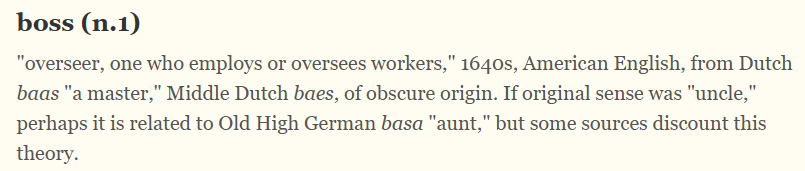
This is largely how the word is used today, someone who ’employs or oversees workers’. That’s pretty straight-forward until a cashier at a fast food restaurant calls me boss. Last I checked, I didn’t inherit a Wendy’s franchise unfortunately (good fries!). That etymology may still be too new where the word goes much further back according to Daily Writing Tips and the Oxford English Dictionary (OED), which has many other definitions and uses. For our purposes the 1600s and Dutch meaning is a good start. So let’s jump back to EtymOnline:

This quickly becomes more apparent how the word can have specific connotation especially in the United States. If ‘boss’ was used interchangeably or to replace ‘master’. While the word changed, the general intent and meaning did not. It was simply a way for people to avoid the use of ‘master’ and refer to another without invoking class or implications one person was superior to the other.
Elizabeth Landau of Wired wrote an article on how technology in general had to confront the use of the words ‘master’ and ‘slave’ which had been prevalent for decades. Despite the technology use not specifically referring to people at all, the implication was still there and it certainly made some uncomfortable. It was compelling enough for BBC to write an article on GitHub’s abandonment of the term ‘master’ to “avoid [a] slavery row”. In the British context, a row is “a noisy disagreement, argument, or fight” according to Grammarist. As an American reading the use of that term more in The Register and other British outlets, the meaning often comes across to me as “controversy” instead.
At this point I have to briefly argue against my own point in fairness, but I will explain why I am fairly sure this was never an intended meaning from the mostly young kids using the word. For a period in the 19th and 20th century the word could be used to address someone unknown to them without showing disrespect. From the OED again:
colloquial (originally U.S.). Used deferentially, humorously, etc., as a form of address to a person (esp. a man, and often someone whose name one does not know).
I argue against this being the reason the younger generation uses it because it isn’t a definition taught in schools. At least, not when I was growing up; boss meant boss as in an employer or manager, the “common” definition in the United States. These days it is fairly typical to address me as “sir” to show respect and that is not ambiguous. However, that tends to be done by Millennials (1981 – 1996) and not by Generation Z (1997 – 2012).
If you ask Google Gemini about the definitions of the word boss, it will give a comprehensive list. I used it out of curiosity to help write this article and was quickly reminded to always check its work. When you ask questions ask it to cite sources and it behaves differently in providing the links backing its answers, which is incredibly helpful. That is where some of the citations above come from while others I dug up.
Amusingly, Gemini provided the definition that is the basis of this article and my sore spot:
4. Modern Usage: Irony and Respect
Today, calling someone “boss” usually falls into one of two categories:
Transactional Respect: Often used by service workers (contractors, mechanics, or vendors) toward a customer. It acknowledges the customer is the one “calling the shots” for that specific transaction.
That is spot on and yet precisely what bothers me. To finally explain the context that my mind invokes it is important to mention that my mother worked in and ultimately ran a county jail for many years. So a lot of our talk about her work was around jail and prison culture. She taught me a lot about inmate behavior which spills out into our world the minute they are released. That stupid trend of sagging jeans in which Wikipedia lists two possible origins leaves out another. It mentions incarceration and lack of belts which is true, but even when clothes fit fine many males did it as a way to demonstrate they had a large penis and in that culture, large genitals translated to strength and power.
Pivoting to ‘boss’ in the context of prison systems, that is the origin that is foundational to me not liking being called that term by anyone unless in a managerial context. Again from Gemini’s summary:
In the context of American prison history, calling someone “Boss” carries a much heavier, more specific weight than it does on the street. It is the primary way inmates address correctional officers (COs), particularly in the Southern United States.
Its usage in prison is a complex survival mechanism that balances respect, sarcasm, and subversion.
Great! That is closer to the root of this evil but that doesn’t show the institutional, meaning correctional system, derivation of its use. Fortunately, Gemini went into real detail in its summary for me and comes very close to saying it:
1. The Mandatory Honorific
In many historical prison systems, especially the “Chain Gang” and “Lease” systems of the late 1800s and early 1900s, inmates were strictly forbidden from using an officer’s name. They were required to use a title of respect to avoid physical punishment.
- Why “Boss”? Much like the civilian origin, “Boss” was used as a “neutral” alternative to “Master.” In the post-Civil War South, where many prisoners were formerly enslaved or the children of the enslaved, “Boss” allowed them to acknowledge the officer’s absolute authority without using the vocabulary of slavery.
2. The “Double S.O.B.” (The Hidden Insult)
A long-standing “back-alley” etymology in prison culture is that “BOSS” is actually a reverse acronym.
- The Legend: Inmates would say “Yes, Boss” while secretly thinking it stood for “Sorry S.O.B.” spelled backward (B-O-S-S).
- The Function: This gave the inmate a sense of psychological victory. By calling the guard “Boss,” they were technically obeying the rules of respect, but in their own minds, they were hurling an insult.
In short, a vast majority of the inmates on these chain gangs were black while the guards were invariably white [1][2][3][4]. While slavery had been abolished in some areas it was still very much a thing in other places, especially the deep south. So you had black inmates calling white guards “boss” for various reasons outlined above. That continued on and is still commonly seen in jails and prisons today.
The deep racial inequality and undertones in using the term “boss” are simply not appropriate for a public business. This is infinitely more important when a black worker calls a white customer that term. I honestly do not think these young kids are using it in that context, or even know about it. Nevertheless, that is how some customers may perceive it for a variety of reasons including its use in TV and movies.
[4/28/2026 – The day before this blog was published, someone I am friendly with at my local grocery store called a customer ‘boss’ between our chatting. Afterwards I told him my blog was timely as it would be informative about the use of the word and gave him the brief rundown. Part of his reply after reading the whole thing today was that there is “something definitely to be said with that about the inherent privilege I have being who I am and the related ‘privilege of ignorance’ so to speak”. I thought that to be a very wise observation for someone so young and it is encouraging to me that just mentioning the derivation of the word in the context I covered can be so well-received by his generation. So I really hope managers or customers have a quick word if an employee uses it.]
Leave a Reply