Sometime in or near 1988, I wrote a signficant portion of an ambitious ~ 40 page paper for middle school history that went well and above expectations. It was definitely a situation of biting off more than we could chew and took a lot of work to finish. Reading this now it is trivial to dismiss as nothing special. However, at the time, there was no modern Internet and no search engines. We had to figure out the lyrics ourselves and go to multiple libraries to figure out the significance of some events. Now, Wikipedia has lengthy pages on each of these topics. To this day, I can (mostly) sing along with the song and remember the lyrics. (Typos and spacing are due to scanning/OCR)
"WE DIDN'T START THE FIRE" - A NEW PERSPECTIVE
Brian Martin & Tom Philbin
U.S. History Mr. Gore Period 5
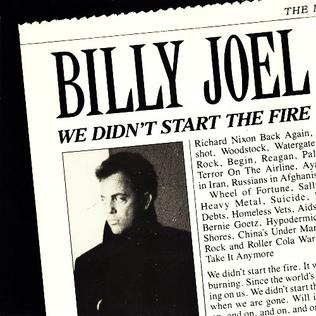
"WE DIDN'T START THE FIRE"
BILLY JOEL
'49 HARRY TRUMAN, DORIS DAY, RED CHINA, JOHNNIE RAY, SOUTH PACIFIC, WALTER WINCHELL, JOE DiMAGGIO,
'50 JOE McCARTHY, RICHARD NIXON, STUDEBAKER, TELEVISION, NORTH KOREA, SOUTH KOREA, MARILYN MONROE
'51 ROSENBERGS, H-BOMB, SUGAR RAY, PANMUNJOM, BRANDO, THE KING AND I, AND THE CATCHER IN THE RYE,
'52 EISENHOWER, VACCINE, ENGLAND'S GOT A NEW QUEEN, MARCIANO, LIBERACE, SANTAYANA GOODBYE
CHORUS
'53 JOSEPH STALIN, MALENKOV, NASSER, PROKOFIEV, ROCKEFELLER, CAMPANELLA, COMMUNIST BLOC,
'54 ROY COHN, JUAN PERON, TOSCANINI, DACRON, DIEN BIEN PHU FALLS, ROCK AROUND THE CLOCK,
'55 EINSJEIN, JAMES DEAN, BROOKLYN'S GOT A WINNING TEAM, DAVY CROCKETT, PETER PAN, ELVIS PRESLEY, DISNEYLAND,
'56 BARDOT, BUDAPEST, ALABAMA, KRUSHCHEV, PRINCESS GRACE, PEYTON PLACE, TROUBLE IN THE SUEZ
CHORUS
'57 LITTLE ROCK, PASTERNAK, MICKEYMANTLE, KEROUAC, SPUTNIK, CHOU EN-LAI, BRIDGE OVER THE RIVER KWAI,
'58 LEBANON, CHARLES DE GALLE, CALIFORNIA BASEBALL, STARKWEATHER, HOMICIDE, CHILDREN OF THALIDOMIDE,
159 BUDDY HOLLY, BEN HUR, SPACE MONKEY, MAFIA, HULA HOOPS, CASTRO, EDSEL IS A NO-GO,
'60 U-2, SYNGMAN RHEE.,PAYOLA AND KENNEDY, CHUBBY CHECKER, PSYCHO, BELGIANS IN THE CONGO
CHORUS
'61 HEMINGWAY, EICHMANN, STARNGER IN A STRANGE LAND, DYLAN, BERLIN, BAY OF PIGS INVASION,
'62 LAWRENCE OF ARABIA, BRITISH BEATLEMANIA, OLE MISS, JOHN GLENN, LISTON BEATS PATTERSON,
'63 POPE PAUL, MALCOLM X, BRITISH POLITICIAN SEX, J.F.K. BLOWN AWAY - WHAT ELSE DO I HAVE TO SAY?
CHORUS
'64-'89 BIRTH CONTROL, HO CHI MINH, RICHARD NIXON BACK AGAIN, MOONSHOT, WOODSTOCK, WATERGATE, PUNK ROCK, BEGIN, REAGAN, PALESTINE, TERROR ON THE AIRLINE, AYATOLLAH'S IN IRAN, RUSSIANS IN AFGHANISTAN, WHEEL OF FORTUNE, SALLY RIDE, HEAVY METAL, SUICIDE, FOREIGN DEBTS, HOMELESS VETS, AIDS, CRACK, BERNIE GOETZ, HYPODERMICS ON THE SHORE, CHINA'S UNDER MARTIAL LAW, ROCK AND ROLLER COLA WARS, I CAN'T TAKE IT ANY MORE!
In our ever changing world there is so much to remember from the past. As we live we just extend the line of time that trails behind us for eternity. Too many emotions, times of pain, problems, and even solutions are taken away by time. People, in their never- nding struggle to move faster and more efficiently, take for granted the sacrifices, discoveries, pain and emotion of every single person who lived and died before us in contribution to our existence.
Those who lived before us created many circumstances for themselves, and for us. Problems and solutions came and went, good times and bad times came and went, good people and bad people came and went. We must remember, learn from and feel these circumstances as we use them for our benefit.
In our time, mine and your lifetime, we hear of and have to deal with many problems. Too many people let these problems get to them too much. We need to take a step back and take a look at the "big picture", and gain perspective.
The following pages of this report help us to do this. It reminds us of the pain, emotions, problems and solutions our world has seen and is still seeing. It reminds us to gain per spective in our lives, at this time. It is history, and it re minds us that "We Didn't Start the Fire".
HARRY TRUMAN - (1949) - Harry Truman was the 33rd president of the United States. He was born in 1884 and died on December 26, 1972. In 1949 Harry Truman had to declare war. Oddly enough, pacifists understood the reason and agreed with Truman's choice to declare war on North Korea. After World War II he started the Cold War and is known for that. [1]
DORIS DAY - (1949) - Starring in 39 motion pictures, Doris Day was popular in the forties and fifties. In 1949 she starred in My Dream is Yours and It's··a Good Feeling. She is best known for singing "Que Sera, Sera". In the late forties she was referred to as "the girl next door to Rock Hudson" because of a role in a film. [2]
RED CHINA - (1949) - In 1949 China formally claimed itself under Communist rule. At first it was controlled under Generalissimo Chiang Kai-Shek. This event helped spark the fear of spreading Communism. As of today China has remained under a single com munist dictator. [3]
JOHNNIE RAY - (1949) - John Alvin Ray, born in Dallas, Texas, was the unfortunate victim of an accident that deprived him of half his hearing. After many years of self taught lessons he gained a reputation for being a great piano player. His second release, "Cry" (1951) became the best selling recording of the next year. He was also known for his display of emotion on stage. [4]
SOUTH PACIFIC - (1949) - South Pacific was a popular musical written by Richard Rodgers and Oscar Hammerstein. In 1949 the play won a pulitzer prize. Rodgers, well known then, has written over 10 operas and many songs. [5]
WALTER WINCHELL - (1949) - Controversy surrounded Walter Winchell through a good part of his life. Born April 7, 1897, he wrote for different reasons in his early teens. He later became a gossip columnist and wrote about controversial items. At times his audience exceeded 50 million. During his life he wrote for over 1000 newspapers. [6]
JOE DiMAGGIO - (1949) - Joe DiMaggio is often considered the last American hero. During his career he was thought to have been one of the greatest outfielders in the history of baseball. He held many records and won a batting title in 1939 and 1940. He played for the New York Yankees from 1936 to 1951. [7]
JOE McCARTHY - (1950) - Joe McCarthy started his career as a fairly regular senator from Wisconsin. It took only a few minutes to make a list of 205 names - people whom he believed to be communists. This started,McCarthyism: the belief that communists were plotting to overthrow the United States government . [8]
RICHARD NIXON . - (1950) - During 1950 Richard Nixon gained fame through convicting Alger Hiss. Although Hiss got off, he later served five years for lying to a grand jury..Hiss was an admitted mem ber of the communist party for over 5 years. [9]
STUDEBAKER - (1950) - The Studebaker was a popular car in the 1950's. The Studebaker Corporation merged with Worthington Corporation. The company had become the first nationwide wagon producer. [10]
TELEVISION - (1950) - Early in 1950 the "Boob Tube" became the latest fad and biggest means of entertainment. By late 1950 it was con sidered an addiction by many people. Today 9&% of homes have at least one T.V. communication. It is now one of the most important means of [11]
NORTH KOREA - (1950) - Because of the Cold War, North Korea thought their ideals were at stake and decided to invade South Korea in June. The war seemed to go all for the North. Three days after the declaration of war the capitol, Seoul, was taken over by the North. Three years later an armistice was signed ending the con flict. [12]
SOUTH KOREA - (1950) - In June of 1950 South Korea found itself in the middle of a mass invasion by the North. From the beginning the South was unprepared for the invasion. After three years of a long struggle, an arm1' st1'ce was signed on July 27, 1953. [13]
MARILYN MONROE - (1950) - Her life was the "classic show b siness tragedy". She was the sex symbol of the late 501s and 60's. She was married several times and among her husbands was Joe DiMaggio. She overdosed on sleeping pills one night which resulted in controversy as to whether her death was murder or suicide. [14]
ROSENBERGS - (1951) - In 1951 Ethel and Julius Rosenberg faced charges of treason. They had been said to be communist spies for sev eral years. It was also thought they sold the plans for the atomic bomb to Soviet agents. After lengthy trials both were found guilty and sentenced to death. Both died of electrocution at 8:06 on June 12, 1953. [15]
H-BOMB - (1951) - The H-bomb, also known as a fusion bomb or hydro gen bomb, was built and developed in 1951. The H-bomb has been controversial since it was created. The bomb works like the sun in that it fuses together two atomic nuclei starting a chain reaction. The bomb is considerably more destructive than the atomic bomb. [16]
SUGAR RAY - (1951) - Sugar Ray Robinson was a well known and well liked boxer in 1951. He won his first middle weight title in 1951 when he beat Jake LaMutta ("The Raging Bull"). He retired in 1965 having won 175 of his 200 professional fights, 109 of them by knockouts. [17]
PANMUNJOM - (1951) - Panmunjom, North Korea, became famous as the site of the truce talks that ended the Korean war. On July 27, 1953, the communist party and United Nations forces signed a truce. Panmunjom lies less than 50 miles north of the 38th parallel. [18]
BRANDO - (1951) - Marlon Brando was a very prominant American actor in the 50's. He was well known for his powerful physical fea tures and shady, sharp personality and voice. He appeared in many American classic films including A Street Car Named Desire, On the Waterfront,and The Godfather. [19]
.
THE KING AND I - (1951) - In 1951 The King and I opened and turned out to be a major success. Yul Brynner starred in this fantastic musical written.by Rodgers and Hammerstein. The musical later went on to win an Academy Award with Yul Brynner as best actor. [20]
THE CATCHER IN THE RYE - (1951) - This book was first published in 1951. It was the topic of much controversy. Some people found the book offensive and tried to ban the book. Even though this book is a good and realistic literary accomplishment, it is almost never read by students in school because of the few "offensive" words it contained. [21]
EISENHOWER - (1952) - Dwight David Eisenhower was the 34th president of the United States and served from 1953-1961. He was a very well-known and well-liked president. Before his presidency he was a General in the U.S. Army and Supreme Commander of the Allied Armies in Europe. While he was president he always did his best to preserve peace with all nations. "Ike" suffered illnesses while he was president but he always recovered. [22]
VACCINE.- (1952) - A vaccine for polio was developed by Dr. Jonas Salk in 1953. Many doctors had been searching for this vaccine, therefore, Dr. Salk's discovery was a major medical breakthrough. In April, 1955, after many tests, the vaccine was pronounced safe and e fective. Salk was offered many honors, including an achievement award from President Eisenhower, but refused to take ny cash rewards. [23]
ENGLAND'S GOT A NEW QUEEN - (1952) - Elizabeth II became the British monarch on February 6, 1952. She became the queen at the early age of 25 because of her father's death. Today Elizabeth II is still Queen of England at age 64. [24]
MARCIANO - (1952) - Marciano was one of the hardest punchers in box ing history. He became the world heavyweight boxing champion on September 23, 1952, when he knocked out Jersey Joe Walcott in the 13th round. He kept this title until 1956 when he retired after winning all of his professional fights. [25]
LIBERACE - (1952) - In 1952 Wladziv Valentino Liberace debuted on. WNBT every Sunday. Liberace is probably most known for his extraordinary piano playing ability. He is also known for his one of a kind collection of pianos and cars. Years later he admitted to being homosexual. The world was shocked when it was learned that he had contracted the AIDS virus and even more shocked when he died becasue of the virus on January 24, 1987. [26]
SANTAYANA GOODBYE - (1952) - George Santayana was a well-known author and philosopher in the 30's and 40's. He wrote many well-known books such as The Last Puritan, and The Life of Reason. Many were saddened by his death in 1952. [27]
JOSEPH STALIN - (1953) - Joseph Stalin was the ruthless Russian leader from 1929-1953. His goal was to industrialize Russia. He treated some Russian citizens as slaves and many resisted. Stalin died in Moscow on March 5, 1952, from a brain hemorrhage. [28]
MALENKOV - (1953) - Georgi Maximilianovich Malenkov took over the job of Russian premier after Stalin's death. Malenkov had a very rocky political career. He was forced to resign so pre mier Nikita Khrushcev and when he tried to regain another political position he was sent to Kazakhstan to manage a power plant. Thirteen years later he was expelled from the communist party. [29]
NASSER - (1953) - Gamal Abdel Nasser was a key person in the act of making Egypt a republic. He overthrew King Faruk in 1952. Nasser later went on to be prime minister and then president of Egypt. He was well liked and respected by the people of his country, and when he wanted to resign as president he was pressured into keeping the job. He died a sudden death in 1970. [30]
PROKOFIEV - (1953) - Sergei Sergeyevich Prokofiev, who wrote the symphonic fairy tale Peter and the Wolf in 1936, is considered to have written the most popular symphony of the 1900's. He was born in Sontsorka in the Soviet Union. As a boy he studied piano, composition, and conducting. Later he settled in Moscow where he wrote many major works. He died in 1953 having com posed some of the greatest musical works in history. [31]
ROCKEFELLER - (1953) - Rockefeller is one of the most famous names in American business, finance, and philanthropy. "It was a family of politically, financially, and socially prominent men." Although all but one of them was alive in 1953, the most famous at that time was John Davidson Rockefeller III because of his philanthropic views and extreme humanitarianism. [32]
CAMPANELLA - (1953) - Roy Campanella was the catcher for the Brooklyn Dodgers. On his 32nd birthday in 1953 he received the MVP (Most Valuable Player). Later in 1955 he received it again. During his career he held many records including the most grand slams in the National League, the most home runs in a season, and the most home runs (3 in a row). Later in life he was paralyzed in a car accident. [33]
COMMUNIST BLOC - (1953) - Late in 1953 communist countries included Poland, East Germany, Czechoslovakia, Hungary, Romania, and Bulgaria. These countries were U.S.S.R. satellites but they were referred to collectively as the Communist Bloc. The only thing that threatened the Bloc was the death of Joseph Stalin. [34]
ROY COHN - (1954) - Roy Cohn assisted Joe McCarthy for 18 months. During this time Roy said a politician can remain the central national figure for only so long before people lose interest. This statement is believed to have brought McCarthy down. Cohn is also known for opposing the senate and wanting to use the exclusi.ve Senate Bathi'ng House. [35]
JUAN PERON - (1954) - Juan Domingo Peron was the elected president of Argentina from 1946-1955 and from 1973-1974. The reason for the interruption between 1955 and 1973 was because he fled from his country after a military revolt. Peron was a military man and won popularity through supporting the army. During World War II he sided with Germany and Japan, and used many of the same militaristic and inhuman tactics to "control'' his country. He remained the president of Argentina until his death in 1974. [36]
TOSCANINI - (1964) - Arturo Toscanini was a famous symphony orchestra and opera conductor. He thought that a performance should not be the outlet of emotion for the performer, but should be a re flection of the composer's feelings. He became quite popular and conducted many famous orchestras. After an unpleasant stay in Italy, Toscanini moved back to the U.S. to conduct for great orchestras like the New York Philharmonic Orchestra. In 1937 NBC formed a world class orchestra called the National Broadcasting Symphony Orchestra, just for Toscanini. He retired in 1954, at the age of 87, two years before his death. [37]
DACRON - (1954) - Dacron is a synthetic fiber that we buy and use every day. This synthetic breakthrough was invented by the DuPont Company in the early 1940's. DuPont is the sole American producer of this polyester fiber that is in many products, such as curtains, fire hoses, and filters. [38]
DIEN BIEN PHU - (1954) - Dien Bien Phu is a Vietnam city that played a key part in the Vietnam war. France was trying to gain and keep control over the Vietnam people. It-was near the end of the war and France was growing weak. When the Vietminh took took over the city of Dien Bien Phu it became evident that France was losing it's grip and that the war was corning to an end. The capture of this city happened on May 7, 1954, and was the result of a 55 day siege. [39]
ROCK AROUND THE CLOCK - (1954) - "Rock Around the Clock" was the first famous rock 'n' roll song to hit America. It was recorded in 1954 by the first famous rock band, Bill Haley and the Cornets, for the 1955 motion picture Blackboard Jungle. The release of this song changed the American music industry forever. [40]
EINSTEIN - (1955) - Albert Einstein is one of the best known scien tists of all time. He was considered a genius and his contri butions to the field of science are overwhelming. Einstein's most famous accomplishment was probably his theory of relativi ty, which was the basis of the atomic age. Albert Einstein died on April 18, 1955. He will always be remembered as one of the greatest scientific minds ever. [41]
JAMES DEAN - (1955) - Dean was a famous American actor who was known for his roles as.tough, rebellious young men. Dean was idolized by many teens after the release of his most famous movie Rebel Without a Cause in 1955. He was also known for his roles in the classic movies East of Eden, and Giant. James Dean died in 1955 in an unfortunate automobile accident in his Porsche at the age of 24. Dean then became hown worldwide as many teens mourned his death. [42]
BROOKLYN's GOT A WINNING TEAM - (1955) - In 1955 the Brooklyn Dodgers beat the New York Yankees four games to three. This upset was seen live by over 350,000 people. 1 Fans came to see Roy Campanella, Joe DiMaggio, and Mickey Mantle play a great game. This was the first world series the Brooklyn Dodgers had ever won. [43]
DAVY CROCKETT - (1955) - Davy Crockett was a famous American fron tiersman. He is ,probably best known for his battle at the Alamo in 1835, in which he died at the age of 50. During his life Crockett was also a prominant political figure. In 1955 hisstory was recreated in a movie in which Fess Parker played Davy Crockett. [44]
PETER PAN - (1955) - Peter Pan is a fictional character of a play, first produced in 1904, by Sir James Barrie. This play became popular, and still is, because of it's universal appeal to the dreams of everyone when they were a child. The play is about a little boy in a world of magic and fantasy, who doesn't grow up. Today this play is still performed and is quite popular. [45]
ELVIS PRESLEY - (1955) - The King of Rock and Roll was the most pop ular musician in the history of rock music. Presley's fame made him rich and led him down a path of drugs to his death. He tra veled the world playing concerts for millions of screaming fans and making movies. Presley first gained fame with the release of his number one hit song, "Heartbreak Hotel" in 1956. Presley died in 1977 at the age of 42. [46]
DISNEYLAND - (1955) - This now famous amusement park was opened by Walt Disney in Anaheim, California, in 1955. The opening of this grand scall park was one of the greatest achievements of Disney's life. Disneyland and Disneyworld are probably the two most famous amusement parks in the world. Most of the rides and other attractions at Disneyland are based
on Disney movie or cartoon figures. [47]
BARDOT - (1956) - Brigette Bardot was considered the sex star of the 50's. She is best known for her film And God Created Women. She started her career in France and later moved to the U.S. where she starred in over 40 movies. She was married three times and had many lovers which started many rumors about her. [48]
BUDAPEST - (1956) - Budapest is the largest city in Hungary and holds 20% of the country's population. Budapest got it's name in 1873 when three cities of Buda, Pest, and Obuda united with Margaret Island. During World War II almost the entire Jewish population of Budapest was destroyed. In 1956 Budapest was often in the American media because Soviet troops marched in and stopped the Germans. [49]
ALABAMA - (1956) - Alabama is the 29th largest state in the U.S. and played a key role for the South in the American Civil War. After the war, racism remained as a social problem. Even to day, although not as bad, this is still a problem. It wasn't until many years after the Civil War that the law stepped in to try and save our 22nd. state. In 1956, with a well publi cized case, the federal court stepped in an made Montgomery, Alabama, desegregate it's bus systems. This was just the beginning of a string of r-ulings to stop segregation and racism in Alabama. [50]
KRUSHCHEV - (1956) - Nikita Sergeyevich Krushchev was the dictator of Russia from 1958-1964. His political ideals were, for the most part, typical of the Russian Communist Party. Although he tactfully kept peace with the United States, Krushchev didn't think, or care, much about lesser nations. He was known for his occasional humorous comment or subtle joking with a Russian citizen. In the early 60's Krushchev began losing his popularity. Many of his promises proved empty and his policies unsuccessful. He retired on October 15, 1964. [51]
PRINCESS GRACE - (1956) - Princess Grace of Monaco became Grace Kelly's title when she married Prince Rainier III of Monaco in 1956. Before her marriage she was a successful and active American actress. She was considered to be beautiful by many young American men. In 1954 she won an Academy Award as best actress for the movie The Country Girl. After she was married she no longer acted. [52]
PEYTON PLACE - (1956) - Grace and George Metalious moved from a $30 a month "shack" to a 9 room Cape Cod house when Grace wrote the book Peyton Place. The book sold over six million copies and was made into a controversial movie. One out of every twenty nine Americans bought the novel. It was a saga of the sex life of a New England town. Thomas Markis sued Grace for $250,000 after using his name in the book. [53]
TROUBLE IN THE SUEZ - (1956) - On November 29, 1956, the Suez Canal war ended. The United Nationa called for a total withdrawal of all invading forces and the U.N. also sent international police to enforce the demand. French and British forces withdrew three
weeks later. During the struggle Israeli forces killed 18,000 and captured another 12,000 as prisoners. [54]
LITTLE ROCK - (1956) - Little Rock is the capitol and largest city in Arkansas. It is a major trading and transportation center for the state. Little Rock was a key city and the location of a battle during the Civil War. In 1957 world wide attention was focused on Little Rock when Governor Orval E. Faubus tried to prevent integration of the city's Central High School. His acts brought on violent riots and showed America that we still had a long way tog before people accepted and respected racial equality in the U.S. [55]
PASTERNAK - (1957) - Boris Pasternak (1890-1960) wrote Dr. Zhivago. This was considered the only truly great novel to come out of post-revolutionary Russia without approval of the Russian Communist Party censorship. Later Pasternak refused a Nobel Prize because of pressure from the Soviets. [56]
MICKEY MANTLE - (1957) - Mickey Charles Mantle ranks among the lead ing home run hitters in baseball history. During one regular season he hit 536 home runs. He spent his entire career with the New York Yankees (1951-1968). He won the MVP (Most Valuable Player) three times in his career. He also hit 18 World Series home runs. He ended his career six years before being elected to the Baseball Hall of Fame in 1974. [57]
KEROUAC - (1957) - Jack Kerouac (1922-1969) was an American author and a leader of the "beat movement". Most of his works describe the tavels of Jack and his friends through the U.S., Mexico, and Europe. His works emphasized sex, drugs, and an Asian religion called Zen. His most famous novel, On the Road, was published in 1957. [58]
SPUTNIK - (1957) - Sputnik was the name of a series of unmanned earth satellites launched by the Soviet Union. Sputnik is Russian for "traveller". On October 4, 1957, Sputnik I was launched and put in orbit around earth. It circled the earth once every 95 minutes (18,000mph). It fell to Earth June 4, 1958. [59]
CHOU EN-LAI - (1957) - Chou En-Lai (also Zhou Enlai) was the premier and foreign minister of China when the communists won control over the country in 1949. He then became foreign minister in 1959. In 1957 he travelled the world making many appearances and speeches. [60]
BRIDGE ON THE RIVER KWAI - (1957) - Bridge on the River Kwai was released in December of 1957. Alec Guiness plays an interned Bri tish soldier living by discipline and the Geneva Convention. This film was done by· blacklisted writers. The actual script is credited to Pierre Balle. It later went on to win an Academy Award. [61]
LEBANON - (1958) - Lebanon retained strong ties with the west until some Lebanese, largely Muslims, rebelled against the government in 1958. In July of 1958 the U.S. sent thousands of Marines by request of the Lebanese government. This intervention helped to restore peace and balance to the government. [62]
CHARLES DE GAULLE - (1958) - Charles Andre Joseph Marie De Gaulle (1890-1970) was in power in May of 1958 when France stood on the verge of a civil war. French officers, who were afraid they would lose support against the Algerian Rebels, seized Algiers. The officers then demanded that De Gaulle head a new government. He accepted and made a consti. tui. on for the fi. fth Republic. [63]
CALIFORNIA BASEBALL - (1958) - In 1958 the Brooklyn Dodgers and New York Giants moved to California beco ing the Los Angeles Dod gers and the San Francisco Giants, thus creating California Baseball. During this time many teams decided to relocate. By doing this, an American and a National League started. [64 ]
STARKWEATHER - (1958) - While driving through Wyoming and Nebraska, Charles Starkweather and a fifteen year old female accomplice named Carol Ann Fugate, killed eleven people. Starkweather was found guilty of eleven cases of homicide and put to death. During the trial he said the girl was taken hostage but later went back on his word and told the jury her innocence was "hogwash". [65]
HOMICIDE - (1958) - This refers to the killings by Starkweather. Homicide is the killing of one person by another. Homicide includes any killing such a mercy killing, murder, manslaughter, and accidental deaths unless for example a small child runs in front of a car. [66]
CHILDREN OF THALIDOMIDE - (1958) - During 1958 a new drug started circulating around England called Thalidomide. It was supposed to be a simple sedative used by pregnant women but it caused tragic deformities in their babies. It was estimated thatover 7000 babies were born with missing arms or legs or have other deformities due to Thalidomide. The U.S. banned all sales of this drug before it reached the states. [67]
BUDDY HOLLY - (1959) - Buddy Holly was a well known·singer and guitar player in the 50's and 60's. He was born in Lubbock, Texas, where he grew up and played songs like "That'll Be the Day", "Peggy Sue", and "What To Do". He died with Richie Valens and J.P. Richardson (The Big Bopper) in a plane crash over Iowa. Lubbock residents raised a statue in his memory. [68]
BEN HUR - (1959) - The novel Ben Hur was written by Lew Wallace in 1880. It was the tale of Christ and his doings. The movie- starred Charlton Heston, Hugh Griffith, ana Martha Scott. It was considered an Oscar-caliber picture. The film, directed by William Wyler, makes a sea battle into a spectacle of blood, bodies and brine. [69]
SPACE MONKEY - (1959) - On May 28, 1959, two "space monkeys" were picked up alive and well from the Atlantic Ocean. A seven pound Rhesus monkey named Able and a one pound squirrel monkey named Baker were sent 360 miles into space while in the nose cone of a Jupiter series rocket. These two monkeys were used to see the effects of high altitude pressure on a living creature. The monkeys were also used to see the effects of speed and G-force on creatures. [70]
MAFIA - (1959) - The mafia is thename of a secret Sicilian terrorist society. The mafia was begun in the 1600's in an attempt to com bat corruption and tyranny. Later lawbreakers slowly took over the mafia. The underground organization is grouped into cells. One cell is made up of 5 people who all swear an oath of fidelity. In 1959 Congress started a group of people designed to uncover the organization. [71]
HULA HOOPS - (1959) - Early in the year 1959, the Hula Hoop was the biggest raze. Hula Hoops, also called "hoop-de-dos" and "spin a-hoops", were considered the biggest aerobic workout of the 50's. It was first used for weight loss and later it was considered a toy. People used them for other things like swimming through them and using them for pet tricks. [72]
CASTRO - (1959) - Fidel Castro became the military dictator of Cuba when he and his followers overthrew the existing government led by Fulgencio Batista. Castro promised the citizens freedom but turned the country into a communist state. Before his successful overthrow he was exiled to Mexico after an unsuccessful raid on army barracks in Santiago de Cuba. [73]
EDSEL IS A NO-GO - (1959) - When the first car called an "Edsel" came out people thought it was too ugly to drive. The car was named after Henry Ford !I's first son Edsel Bryant Ford. Ford i now a leading manufacturer of automobiles in the world. [74]
U-2 - (1960) - During May of 1960, Francis Powers was making a routine flight high above the u.s.s.R. when he was shot down. The U-2 plane and all of its photographs it had been taking were lost. Powers survived and later confesses to being in a spy plane after being captured. President Eisenhower accepted full responsibil ity and told everyone that the U-2s had been flying over the U.S.S.R for four years. [75]
SYNGMAN RHEE - (1960) - Syngman Rhee led a large struggle to gain power in the Republic of Korea. During his struggle he was put in jail at age 19 for leading a student demonstration. In 1948, after 20 years of exile in Hawaii, he became the first president of the Republic of Korea. He left office in 1960 and died five years late . [76]
PAYOLA - (1961) - On May 19, 1960, eight disc jockeys (D.J.s) were sentenced to prison for accepting over $100,000 in bribes. Of ten D.J.s ould receive $25 for playing a song. One jockey was accused of playing one song nine times in four hours. Three major radio stations were blamed: KDAY in Los Angeles, WINS and WABC of New York. [77]
KENNEDY - (1960) - After graduating from Harvard, John Fitzgerald Kennedy, also known as JFK, was soon elected to the House of Representatives and later to the Senate. In 1961 he became the youngest president ever. At age 43, many people had high hopes for this Democrat from Massachusetts. [78]
CHUBBY CHECKER - (1960) - On October 18, 1960, a new dance called the "twist" hit the dance floor. It started with Chubby Checker doing a twist in the Stork Club and Peppermint Lounge. He had started a craze before he went to Europe. At 19 years old he went on a European tour which also resulted in a "twist" craze on that continent. [79]
PSYCHO - (1960) - Psycho was a horror movie that came out in 1960. To many's surprise, people were truly scared for the first time. The movie is about a man named Perkins who runs an old motel called the Butes Motel. The place has twelve rooms that constantly stayed vacant. This film is still considered the best horror film by some. [80]
BELGIANS IN THE CONGO - (1960) - During the late 50's, Middle Congo gained internal self-government. Until then Belgians occupied the Congo as law enforcers. When the Congo became independent in 1960 this forced the Belgians out. [81]
HEMINGWAY - (1961) - Ernest Miller Hemingway was an American author who wrote many notable works in his lifetime. During his early years he served in World War II which some believed contributed to his failing health in later years. He won a Pulitzer prize for a novel The Old Man and The Sea in 1952. In 1961 he gave
into his failing mental and physical health by committing suicide with a shotgun. [82]
EICHMANN - (1961) - A lieutenant colonel in the Nazi Secret Police by the name of Adolf Eichmann played a part in the death of over 6 million Jewish people during World War II. After the war he relocated to Argentina. In 1960 he was seized by Israeli agents. Later he was sentenced to death and hanged in 1962. [83]
STRANGER IN A STRANGE LAND - (1961) - Born in Butler, Missouri, Robert A. Heinlein wasn't well known until he wrote and published the book Stranger in a Strange Land. Written in 1961, the book disputes many traditional ideas on morals, religion, sex, and mysticism. His views throughout the novel lean toward a Libertarian attitude. [84]
DYLAN - (1961) - Robert Zimmerman, better known as Bob Dylan, was a popular American folk singer, musician, and composer from Duluth, Minnesota. As a child and in his early teens he learned to play the guitar as well as the harmonica and piano. His most well known composition was "Blowin' in the Wind". In 1961 Dylan was a hit when he toured through Greenwich village. [85]
BERLIN - (1961) - In 1961 the Berlin Wall was completed and it seemed to be permanent. It is referred to as "the wall of shame" by many Europeans. The wall is built of concrete and lined with barbed wire, land mines, and guard stations. It totally sur- rounds East Berlin and it served its purpose very well, think some people. On November 11, 1989, at 6:50 A.M. the wall "came down". This is considered the biggest step toward German reunififcation. [86]
BAY OF PIGS INVASION - (1961) - On April 25, Armenian trained anti Castro exiles invaded their Cuban homeland. The attack was a miserable failure. The Russian leader at the time accused Kennedy of planning the whole thing. Before the invasion Castro convinced everyone to take arms or they would die. On April 14, 1962, Cuba convicted 1179 Cuban exiles that helped in the invasion. [87]
LAWRENCE OF ARABIA - (1962) - T.E. Lawrence, the main character in the book and movie, was a British soldier, adventurer, poet, philosopher, and artist. He is sent to unite Arabian tribes and finds himself in a godlike situation. His lust for killing ends up to be his downfall. The movie tries to explain this thoughts and feelings. [88]
BRITISH BEATLEMANIA - (1962) - The Beatles became the most popular group in rock music history. George Harrison, John Lennon, Paul McCartney, and Ringo Starr were all born in Liverpool, England. They named themselves the Beatles in 19060 and became a major hit in Britain during 1962. In 1970 the group broke up which was a shock to the music world. [89]
OLE MISS - (1962) - The University of Mississippi brought major atten tion to itself when James Meredith tried to enroll in an all white college. Violence broke out when people showed up to op pose or support Meredith. Riots were started but before they got out of hand U.S. Marines were brought in to stop the violence. They did their best but couldn't stop two deaths. James Meredith enrolled but dropped out a few years later because of the pressure. [90]
JOHN GLENN - (1962) - John Herschel Glenn, Jr. was the first American to orbit earth. He made his historic journey February 20·, 1962. While in space he orbited the earth three times in five hours. The journey started at 9:47 A.M. (EST) and four hours and fifty six minutes later he landed in the Atlantic ocean at 2:43 P.M. [91]
LISTON BEATS PATTERSON - (1962)·- In 1962 Sonny Liston challenged the world heavy weight champ Floyd Patterson to a boxing match. Af ter the fight started Sonny Liston disappointed almost every fan when he knocked out Patterson with a crushing victory blow in the first round. These few minutes allowed him to walk away with the world heaavy weight championship belt. [92]
POPE PAUL - (1963) - Pope Paul VI was appointed Pope in 1963. As soon as he began his tenure he faced the problem of updating the Roman Catholic Church without discarding certain beliefs that were essential. He had extensive experience while being a priest, ,archbishop, and a cardinal throughout his life. His most controversial act was his letter, the Humanae Vitae, concerning birth control. [93]
MALCOLM X - (1963) - Malcolm X was the most powerful and brilliant voice of the nationalist revival. He believed that blacks must resist violence any way necessary. He also believed segregation was forced upon inferiors by superiors. He was killed by three assassins in 1964. [94]
BRITISH POLITICIAN SEX - (1963) - John Dennis Profimo was accused of having sex with a 21 year old prostitute named Christine Keeler. This event led to the downfall of certain parliament members and destroyed the trust of the citizens. British Prime Minister Harold MacMillan and Conservative Party leaders had a hard time establishing credibility after the incident. [95]
JFK BLOWN AWAY - (1963) - While driving in a parade in Dallas, Texas, John Fitzgerald Kennedy was shot to death November 22, 1963. The assassin, Lee Harvey Oswald, was killed him self on his way to the trial. The death of JFK was mourned by millions. Several countries sent representatives to attend the funeral wi'th full mil1tary honors. [96]
BIRTH CONTROL - (1964) - In 1964 "the pill" went on the market. Birth control is now used by most American couples, however this isn't the limit of its use. Over 80 countries have birth control pro grams and emphasize the use of the pill. Another issue has be come important recently. Abortion is a constant topic of debate and politics. Laws have been made but not put into effect be- cause they can't be agreed on. [97]
HO CHI MINH - (1969) - Ho Chi Minh was born in 1890 in Nguyen Van Thanh. When he was 30 years old he became a communist. He gained popularity when he defeated the French rulers control ling Vietnam in 1954. He served as president of North Vietnam from 1954 until his death in 1969. Six years after his death communist forces took control of South Vi tnam. In tribute, Vietnam named the city of Saigon after him. [98]
RICHARD NIXON BACK AGAIN - (1972) - In 1972 Richard Nixon was re elected president of the United States. His actions that stop ped U.S. military actions in Vietnam helped him win the presi dency again. On August 9, 1974, he was the first president to resign. If he hadn't resigned he would have faced impeachment for his involvement in the Watergate scandal. [99]
MOONSHOT - (1969) - The Apollo 11 rocket allowed Neil Armstrong and Edwin E. Aldrin,Jr. to land on the moon on July 20, 1969. This successful attempt was referred to as the moonshot. The voyage in space lasted 8 days. During that time the astronauts collected useful data and performed scientific experiments. [100]
WOODSTOCK - (1969) - Over 400,000 people showed up for a concert that took place in Bethel, New York (near Woodstock). The concert called Woodstock featured bands such as Jefferson Airplane, Grateful Dead, the Who, and Jimi Hendrix. It was held to promote peace and anti-war messages. The concert took place on a 600 acre farm owned by Max Yasgur. [101]
WATERGATE - (1972) - Watergate is considered the biggest political scandal in U.S. history. It got its name from the Watergate complex in Washington, D.C.. On June 17 five men were arrested for breaking into the Democratic Party's national headquarters. One year later, five of the seven men involved pleaded guilty. The other two were found guilty later by jury. This scandal showed no greed but attacked the chief features of a democracy-free and open elections. [102]
PUNK ROCK - (1978) - Punk Rock brings people like Sid Vicious who would often perform in a stupor while bleeding from self in flicted wounds. In 1978 he stabbed his girlfriend to death. Before that he was in an out of many drug and alcohol rehab centers. He played the lead guitarist for the Sex Pistols. [103]
BEGIN - (1978) - Menachem Begin became the Prime Minister of Israel in 1977 as the leader of the Likud Party. The party came to power after they won majority on the Knesset, (Israeli Parlia ment) which Begin had served on since 1949. In 1978 Anwar el-Sadat of Egypt, Jimmy Carter of the United States, and Menachem Begin began talks on how to end the Arab-Israeli Conflict. [l04]
REAGAN - (1B80) - Ronald Wilson Reagan was elected president in November of 1980. He was the former governor of California and a well known movie star and TV personality. He was sworn in on January 20, 1981, while American prisoners were being set free in Iran. Reagan served two terms and left office at age 77. [lOS]
PALESTINE - (1980) - In 1979 and 1980 a conference was held in Camp David, Maryland, (neutral grounds) between the United States, Egypt, and Israel. The conference dealt with "full autonomy" for Palestinians under a self governing authority. After years of talks and debates the negotiations were abandoned in 1981. [106]
TERROR ON THE AIRLINE - (1980) - During 1980 there were an increasing number of hijackings. Almost all of the hijacked planes were taken to Cuba. The epidemic of hijackings was considered to be growing when six flights were commandeered in one week (three on Saturday!) Most of the "terrorists" said they did it because they were homesick. [107]
AYATOLLAH'S IN IRAN - (1980) - Almost a year had passed since Aya tollah Ruhollah Khomeini had gained power, when he delivered a speech in Iran. The speech was about anarchy and its effects. He believed that the Islamic Revolution might flounder on its own existance. During the speech there was a lot of protest. After revolutionary guards had stopped the rioting, five people were dead and over 300 more were wounded. [108]
RUSSIANS IN AFGHANISTAN - (1980) - 70,000 Soviet troops faced more. and more opposition in February of·1980. A majority of the re bels were women and children but some were armed men. After all the violence had stopped close to 500 Afghans ended up dead and more wounded. Russian troops faced over 1500 dead and 3500 wounded from the guerillas and rebels. [109]
WHEEL OF FORTUNE - (1983) - The very first telecast of Wheel of For tune was in 1953. It started with guests that had done a good deed and won prizes for it. Later in 1975 a daytime show hosted by Chuck Woolery was introduced. Now in the eighties Pat Sajak and Vanna White host the show. The show has changed again since Sajak took over. It is now one of the most popular game shows today. [110]
SALLY RIDE - (1983) - A thirty two year old physicist named Sally Ride was the first woman to be put in space. She was chosen because she was exceptionally skilled in maneuvering the mech anical arm. Many people said she wanted to go only to be the "first woman in space". She argued that she had the skill and she wanted to do it for herself. [111]
HEAVY METAL - (198O's) - The eighties brought about a new kind of music called Heavy Metal. Often the lyrics were repulsive, gross, and obscene when you could understand them. Groups sprang up everywhere singing and shouting to the deafening sounds. A few groups were connected to satanism and the worshipping of devils. Some lyrics encouraged the use of drugs and alcohol while other lyrics encouraged suicide. [112]
SUICIDE - (198O's) - As more and more problems arose in the eighties more and more people couldn't deal with society. Those people saw suicide as the only alternative. Teenagers using drugs and listening to Heavy Metal would ofted commit suicide. [113]
FOREIGN DEBTS - (197O's & 198O's) - During the 7O's and 8O's many countries started to grow more and more concerned with their national debt. Many countries owed the U.S. money we lent them during the last world war and other nonmilitary goods theyused to help survive. Our own national debt is in the trillions of dollars. [114]
HOMELESS VETS - (197O's and 198O's) - When Vietnam veterans returned from duty they found themselves hated by many Americans because they didn't "fit in". Shelters were built to help those veter- ans that had a drug or alcohol problem. In August of 1988, one veteran barricaded himself in Fort Vancouver Park to show people the lack of help the government showed. He surrendered later for a chance to talk to reporters. This is one example of how the veterans reacted to the resentment. [115]
AIDS - (1981) - During December of 1981 doctors discovered a virus that still has no known cure. AIDS (Acquired Immune Deficiency Syndrome) destroys the body's immune systems. An AIDS victim suffers from severe weight loss, weakness, and often succumbs to many infections. The virus can affect anyone, but is most often associated with intraveneous drug users. [116]
CRACK - (1985) - A new form of cocaine was discovered in 1985. The substance called Crack is a purified, less expensive form and is quite addictive. It hit the streets of New York in 1985. The drug is smoked rather than snorted and it accelerates the climb toward addiction. [117]
BERNIE GOETZ - (1984) - One night on the way home Bernie Goetz was approached by four black youths whom he shot when they threaten ed him. Goetz willingly surrendered to the police and confessed to everything. He was later tried and found not guilty of mur der. He was, however, charged with not having a license to carry the gun. His actions brought up the question of how far you can go in self defense. [118]
HYPODERMICS ON THE SHORE - (1988) - On July 6, 1988, waves of sewage, syringes, blood vials, and infected hospital waste washed ashore on Long Island. Earlier that week 120 vials of blood washed up in Bayonne, New Jersey. Blood in the vials tested positive for AIDS virus. For many weeks hospital waste washed up on the shore around New York. The source of the waste was never found but some evidence points that it may not have come from the hospitals. [119]
CHINA'S UNDER MARTIAL LAW - (1989) - In 1988 and 1989 many citizens of China staged pro-democracy marches. The Chinese army crushed a large protest in Beijing by killing hundreds of people. Mar tial law was set on May 20, 1989 because of mass rioting and pro test. For days after martial law was set, high position leaders hid from the public. The army was delayed because of blockades set by the protesters. [120]
ROCK AND ROLLER COLA WARS - (1g801s on) - During the eighties Coca Cola an Pepsi hired popular musicians to advertise their pro ducts. Major stars such as Michael Jackson would sing parts of songs altered to advertise a product. This method of advertising has continued into the nineties. [12l]
Each of the preceding items has played a part, in one way or another, in our lives. Learning about and remembering each of these topics helps to preserve the past and improve the future. As we look over, research, and recite the facts of the past and present we must remember that they are not just facts. They are emotions, pain, suffering, happiness, discovery, tragedy, sadness, solution, and an infinite number of qualities that I do not have the time or paper to mention.
As you read through this report I hope that, not only an understanding of each topic is gained, but also an understand ing of perspective; the relation of our lives, problems, feelings and solutions to that of the whole. I also hope the im- portance of our time and actions is realized. The time that we are in now will teach and help the future if all of the same qualities are remembered.
"We didn't start the fire", but we keep it alive with everything we do. "When we are gone will it still burn on, and on, and on, and on, and on..."
FOOTNOTES
1. Alonzo L. Hamby, Beyond the New Deal: Harry s. Truman. (New York and London: Columbia University Press. 1973.) p.74.
2. A.E. Hotchner, Doris Day Her Own Story. (New York: William Morrow and Co., Inc.. 1976.) ppw 62-63.
3. Gary May, China Scapegoat. (Washington, D.C.: New Republic Books. 1979.) p. 12.
4. Chronicle of the 20th Century. (Mount Kisco, N.Y.: Chronicle Publications Inc. 1987.)
5. World Book Encyclopedia. (Chicago: World Book, Inc. 1983) Vol. 18.
6. Herman Klurfeld, Winchell, His Life and Times. (New York: Praeger Publishers. 1976) p.. 44.
7. Al Silverman, Joe DiMaggio, The Golden Year, 1941. (Englewood, Cliffs, N.J.: Prentice Hall Inc. 1969.) p. 21.
8. Edwin R. Bayley, Joe McCarthy and the Press. (Wisconsin: The University Press. 1981.) pp. 214-217.
9. Fawn M. Brodie, Richard Nixon, The Shaping of His Character. (New York: W.W.Norton and Co. 1981.) p.97.
10. World Book Encyclopedia. (Chicago: World Book, Inc. 1983.) Vol. 18.
11. Ibid. Vol.19.
12. Mathew B. Ridgeway, The Korean War. (New York: Doubleday and Company Inc. 1967.) p.56.
13. Ibid., p.58.
14. Sandra Shevey, The Marilyn Scandal. (New York: William Morrow and Co., Inc. 1987.) p. 2 and p. 152.
15. Ronald Radosh and Joyce Milton, The Rosenberg File. (New York: Holt, Rinehart and Winston. 1983.) p. 23.
16. Nigel Calder, Nuclear Nightmares. (New York: The Viking Press. 1979.) p. 63-64.
17. World Book Encyclopedia. (Chicago: World Book, Inc. 1983.) Vol. 16.
18. Ibid. Vol. 15.
19. Ibid. Vol. 2.
20. Hugh .Ferdin, Oscar Hammerstein II. (New York: Random House. 1927.) p. 17.
21. World Book Encyclopedia. (Chicago: World Book, Inc. 1983) Vol. 17.
22. Ibid. Vol. 6.
23. Ibid. Vol. 20.
24. Ibid. Vol. 6.
25. Ibid. Vol. 13.
26. Bob Thomas, Liberace. (New York: St. Martin's Press. 1987.). p. 23.
27. World Book Encyclopedia. (Chicago: World Book, Inc. 1983.) Vol. 1 7.
28. Ibid. Vol. 18.
29. Ibid. Vol. 13.
30. Ibid. Vol. 14.
31. Chronicle of the 20th Century. (Mount Kisco, N.Y.: Chronicle Publications Inc. 1987.)
32. World Book Encyclopedia. (Chicago: World Book, Inc. 1983.) Vol. 16.
33. Chronicle of the 20th Century. (Mount Kisco, N.Y.: Chronicle Publications Inc. 1987.)
34. Ibid.-
35. Nicholas Von Hoffman, Citizen Cohn. (New York: Double Day. 1988.) p. 17.
36. World Book Encyclopedia. (Chicago: World Book, Inc. 1983.) Vol. 15.
37. Ibid. Vol. 19.
38. Ibid. Vol. 5.
39. Ibid. Vol. 5.
40. Ibid. Vol. 16.
41. Ibid. Vol. 6.
42. Ibid. Vol. 5 •
43. Glenn Dickey, The World Series Since 1903. (New York: Stein and Day Publishers. 1984.) p. 66.
44. World Book Encyclopedia. (Chicago: World Book, Inc. 1983.) Vol. 4.
45. World Book Encyclopedia. (Chicago: World Book, Inc. 1983.) Vol. 15.
46. Ibid. Vol. 15.
47. Ibid. Vol. 5.
48. Ibid. Vol. 2.
49. Ibid. Vol. 2.
50. Ibid. Vol. 1.
51. Ibid. Vol. 11.
52. Ibid. Vol. 11.
53. Look Magazine, Volume 22: 108-110 (March 18, 1958.)
54. Chronicle of the ZDth Century. (Mount Kisco, N. y.: Chronicle Publications, Inc. 1987.)
55. World Book Encyclopedia. (Chicago: World Book, Inc. 1983.) Vol. 1.
56. Ronald Hingley, Pasternak-A Biography. (New York: Alfred A. Knopf, Inc. 1983.) p. 12-43.
57. World Book Encyclopedia. (Chicago: World Book, Inc. 1983.) Vol. 13.
58. Ibid. Vol. 11.
59. Ibid. Vol. 18.
60. Ibid. Vol. 21.
61. Chronicle of the 20th Century. Publications, Inc. 1987.) (Mount Kisco, N.Y.: Chronicle
62. World Book Encyclopedia. (Chicago: World Book, Inc. 1983.) Vol.12.
63. Ibid. Vol 5.
64. Ibid. Vol. 2.
65. Chronicle of the 20th Century. (Mount Kisco, N.Y.: Chronicle Publications, Inc. 1987.)
66. World Book Encyclopedia. (Chicago World Book, Inc. 1983.) Vol. 9.
67. Ibid. Vol. 19.
68. Chronicle of the 20th Century. (Mount Kisco, N.Y.: Chronicle Publications, Inc. 1987.)
69. Chronicle of the 20th Century. (Mount Kisco, N.Y.: Chronicle Publications, Inc. 1987.)
70. Ibid.
71. World Book Encyclopedia. (Chicago: World Book, Inc. 1983.) Vol. 13.
72. Chronicle of the 20th Century. (Mount Kisco, N.Y.: Chronicle Publications, Inc. 1987.)
73. World Book Encyclopedia. (Chicago: World Book, Inc. 1983.) Vol. 3.
74. Ibid. Vol. 6.
75. Ibid. Vol. 20.
76. Ibid. Vol. 18.
77. Chronicle of the 20th Century. Publications, Inc. 1987.) (Mount Kisco, N.Y.: Chronicle
78. World Book Encyclopedia. (Chicago: World Book, Inc. 1983.) Vol. 11.
79. Chronicle of the 20th Century. (Mount Kisco, N.Y.: Chronicle Publications, Inc. 1987.)
80. Ibid.
81. World Book Encyclopedia. (Chicago: World Book, Inc. 1983.) Vol. 4.
82. Ibid. Vol. 9.
83. Ibid. Vol. 6.
84. Ibid. Vol. 18.
85. Ibid. Vol. 5.
86. Ibid. Vol. 2.
87. Chronicle of the 20th Century. (Mount Kisco, N.Y.: Chronicle Publications, Inc. 1987.)
88. Ibid.
89. World Book Encyclopedia. (Chicago: World Book, Inc. 1983.) Vol. 2.
90. Ibid. Vol. 13.
91. Ibid. Vol. 8.
92. Chronicle of the 20th Century. (Mount Kisco, N.Y.: Chronicle Publications, Inc. 1987.)
93. World Book Encyclopedia. (Chicago: World Book, Inc. 1983.) Vol. 15.
94. Richard T. Schaefer, Racial and Ethnic Groups. (Illinois: Scott, Foresman Co. 1990.) p. 65-66.
95. World Book Encyclopedia. (Chicago: World Book, Inc. 1983.) Vol. 11.
96. Ibid. Vol. 2
97. Ibid. Vol. 9
98. Ibid. Vol. 14.
99. Ibid. Vol. 13.
100. Chronicle of the 20th Century. (Mount Kisco, N.Y.: Chronicle Publications, Inc. 1987.)
101. World Book Encyclopedia. Vol. 21. (Chicago: World Book, Inc. 1983.)
102. Chronicle of the 20th Century. (Mount Kisco, N.Y.: Chronicle Publications, Inc. 1987.)
103. World Book Encyclopedia. (Chicago: World Book, Inc. 1983.) Vol. 2.
104. Chronicle of the 20th Century. (Mount Kisco, N.Y.: Chronicle Publications, Inc. 1987.)
105. Ibid.
106. Ibid.
107. Time Magazine. August 25, 1980. p. 32.
108. Newsweek Magazine. June 23, 1980. p. 17.
109. U.S. News and World Report..March 10, 1980. p. 25.
110. Tim Brooks and Earle Marsh, Complete Directory to Prime Time' Network TV Shows. (New York: Ballentine Books. 1979) p. 98.
111. Chronicle of the 20th Century. Publications, Inc. 1987.)
112. Ibid. (Mount Kisco, N.Y.: Chronicle
113. Ibid.
114. Ibid.
115. Ibid.
116. Ibid.
117. Ibid.
118. Chronicle of the 20th Century. (Mount Kisco, N. y.: Chronicle Publications, Inc. 1987.)
119. Time Magazine. July 18, 1988. p. 28.
120. Chronicle of the 20th Century. (Mount Kisco, N. Y. : Chronicle Publications, Inc. 1987.)
121. Ibid.
Leave a Reply