

I write a lot. Most recently it has been about information security, movie reviews, so-called AI, and a few other topics. It’s been four years since I blogged about my poor experience with Abbott’s Libre2 glucose sensor technology and all the shortcomings. Since then I have tweeted to them a considerable amount when my continuous glucose monitor (CGM) dies, which is an increasing occurrence. I have also been on the phone with their support several times, with one call lasting almost an hour as I discussed all the issues of the Libre2 CGM. It’s quite fair to say that I have gone above and beyond in trying to help Abbott improve their product between blogs, Tweets, and phone calls. There is also no denying that they are aware of the various bugs and sensor failures.
I hope this becomes the most important blog as Abbott becomes fully aware of how their lack of attention to this can lead to serious medical events. I use those words because part of the customer support script is to ask if a sensor failure led to a serious medical event, or words very close to that. In each prior time I answered “no” but reminded them “it could have in some situations”. This time though, I have to tell them yes it did. Due to a combination of flaws in their software, along with poor design choices, I almost died yesterday morning. I woke up to a reading of 43, a level that can induce permanent coma and death. That is not hyperbole either.
Waking up like I did is a normal occurrence, almost every morning I have the same routine. Check glucose, eat a piece of candy if needed, and urinate. This time was different when I saw the 43 and realized the alarm had not fired, and real concern struck me returning to bed minutes later to find it was below 40. Having ‘bottomed out’ plenty of times in my life, as it is informally known, I knew that panicking would do no good. So I ate candy, layed in bed and waited for my glucose to get to 50 and show it was still trending upward before returning to sleep.
I type this blog as I am currently fighting with Abbott’s social media support via Twitter DMs, trying to get a replacement for a sensor that died last week while on vacation. And just wait until they learn I get to open a new case for another that died yesterday morning after failing to notify me I was almost dead. Again, that is not hyperbole.
Background
We need to start with a very abbreviated primer on diabetes, glucose, and the purpose of the sensor. I am a Type 1 (T1) diabetic which means my body produces a negligible amount of insulin requiring me to inject the insulin via needle subdermally to regulate my blood sugar (glucose). You measure your blood sugar levels traditionally using a ‘finger prick’ to draw blood, test strip, and glucometer which gives you a simple numeric reading. If your blood sugar is around 100, you are basically a ‘normal human’. If below 70 you are suffering from hypoglycemia which can cause a list of symptoms that include seizures. If below 50 it is incredibly serious because “if it continues untreated — long-term brain damage or even death” can happen. Let that sink in. So how low was my blood sugar yesterday morning while I was sleeping? Below 40.

Yes, it was so low that the Libre3 CGM I use could not give me an accurate reading. I know from experience that it will show a reading of 40 then if below that, “LO“. That means my glucose was 39 or lower. It’s considered “a life-threatening emergency” that requires immediate medical attention. At that level the biggest risk is slipping into a diabetic coma, one that I would not wake up from without the care of an emergency medical technician (EMT) or a hospital, and even then might not wake up from ever. Glucose at that level can kill a person.
Friends of mine know that I am extremely aware of my diabetes, that I have a spreadsheet tracking food intake, glucose levels, and more. After 25 years of living the diabetic life you learn how your own body reacts to the condition because that can vary greatly from person to person.
The Incident
Most diabetics with that glucose level can not wake up, check their glucose, pop candy in their mouth, go to the bathroom, urinate, return to the bed, check their phone, see the reading, and not panic. When I woke up, solely because I had to urinate, my blood sugar was 43. I immediately ate some candy I keep by the bed for low glucose instances. By the time I got back to bed it read “LO” so it was still dropping. By now I hope you are wondering why this happened. Surely there is technology that should warn you of this life-threatening emergency?
There is! I was using it actually and it failed to do its job and help keep me alive. What’s worse is that I knew this day would come at some point. I knew that I could potentially die when it did happen because that is a gamble you live with as a diabetic dependent on untrustworthy technologies to keep you alive. Abbott has failed to fix the problems in their technology for four years. I know that because I have reported these bugs repeatedly as mentioned above, and to date they have not been addressed. I had originally reported them in the Libre2 and the corresponding Libre2 app. After that there was a Libre3 app and now just the ‘Libre’ app. That means the same issues have persisted through three different apps and the corresponding two physical CGMs.



The Failures, Plural
A CGM system like Libre or DexCom uses a physical sensor that attaches to your body and sends glucose readings wirelessly to a physical glucometer or an app on your mobile phone. If designed properly this is the powerful tool that keeps diabetics healthy. When designed poorly and/or has flaws in the software, it can seriously degrade your overall health. Uncontrolled blood sugar levels leads to the decline in your body in several ways as diabetes will attack almost every organ in some manner. For example, I currently have stage 2 chronic kidney disease (CDK), high blood pressure without medication, and high cholesterol without medication among other minor issues. Controlling high blood sugar and blood pressure are the two largest factors in warding off further decline in my CKD.
High blood sugar is what basically causes diabetes to work faster in attacking your body. The longer you go with uncontrolled high glucose the more damage it does and arguably removes months or years of your lifespan. That is why it is critical to monitor and keep it under control. On the other hand, low blood sugar or hypoglycemia can cause immediate risk. The CGM’s job is to warn me of high or low glucose. It does this through preset alarms configured to throw a warning at specific glucose levels.

Of the three alarms, I have control over two of them. I can configure the ‘Low Glucose Alarm’ and the ‘High Glucose Alarm’ based on my preferences. If my blood sugar is trending down and hits 70, the alarm should throw and I respond by eating anything with sugar/carbohydrates. Candy is great as it dissolves pretty fast and helps adjust, or drinking a few sips of e.g. Coca-Cola is even faster. If my glucose is trending up and hits 170 it tells me that I might need to take insulin to correct. I emphasize that “might” because that isn’t necessarily the case. After a meal your blood sugar will spike, diabetic or not. For regular humans your pancreas kicks into gear and delivers insulin to regulate. It’s faster and more potent than injected insulin.
For diabetics that spike happens as food will hit the system faster than injected insulin will. So if I take insulin minutes before a meal I know there will be a big spike in blood sugar and then it will hopefully drop to a good level after. If I am off on the insulin dose it may stay high, or if I take too much it will drop to a low number. So back to the alarms, notice that I cannot add additional alarms? That is a serious oversight in app design. I should be able to add as many as I want because this current design consistently leads me to having high insulin. Having a second high alarm set to 200 would tell me that I definitely need to address it rather than getting the 170 alarm and thinking that I took enough insulin and it will drop as I expect.
Next, and this is the important one for the story here, notice the ‘Urgent Low Glucose Alarm’. It is set to 55 and cannot be changed. More importantly it has a specific feature that is extremely important that you cannot turn off either:
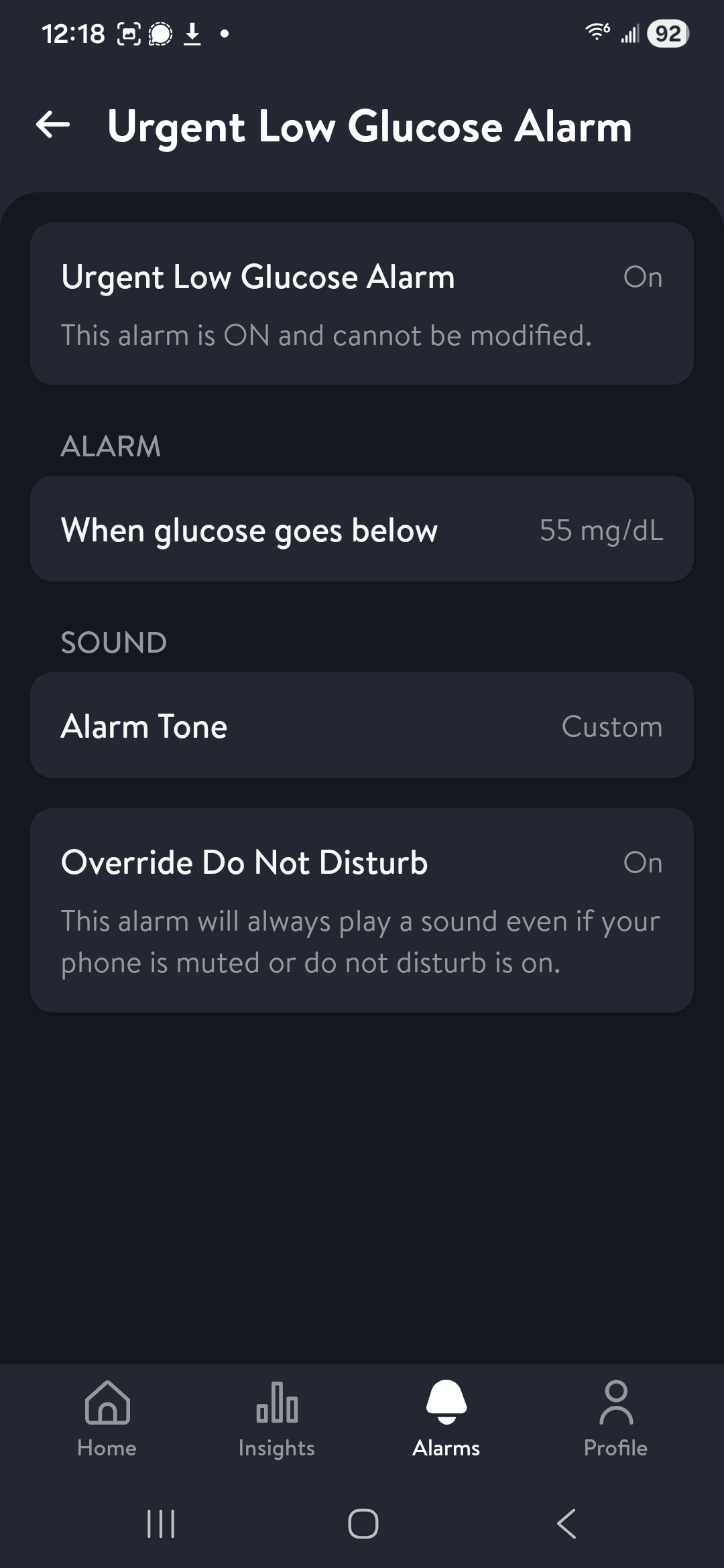
Specifically, note the ‘Override Do Not Disturb’ (DND) option, which is set to ‘On’. That means if my phone is set to DND this alarm should throw due to the serious medical event that is occurring. I have my phone configured to go into DND mode from 11pm to 9am and it was on last night as usual. However, when my blood sugar dropped to 55 the alarm did not throw. This life-saving technology failed to do exactly what it was designed for, and failed to throw the alarm which I guarantee you, will wake me. The alarm is so obnoxious that when it goes off in a room with a couple specific friends, they jump-react to it. The Libre2 would actually play it at max volume regardless of phone settings. When your phone is in DND mode it should default to max volume too.
While I was sleeping and my blood sugar slowly dropped overnight, which is normal, it dropped farther than usual and hit 55. The alarm didn’t go off and my glucose continued to drop to 43. That is when I woke up, again, not because of my glucose at all. When I returned from the bathroom and saw ‘LO’ I knew the candy I had eaten minutes before would kick in relatively quickly.
This all begs the question, why didn’t the alarm go off as it should? This goes back to that Libre2 blog under “How Buggy are the Alarms?”. The second bullet point there says:
In addition to overriding DND, the app will actually set DND on when it should not be able to do it and no configuration option instructs the app to do that.
That’s essentially the true life-threatening bug with the new Libre app. There have been multiple times, including last night, where Abbott’s software is changing the notification status to silent. When it hits 11:00pm, my volume is set to around 30 – 40% usually and DND kicks in. The Libre app, when there is a low glucose incident, is turning the notifications / volume from audible to silent instead of firing the alarm. So the next morning when DND turns off, this is the state my phone is left in:
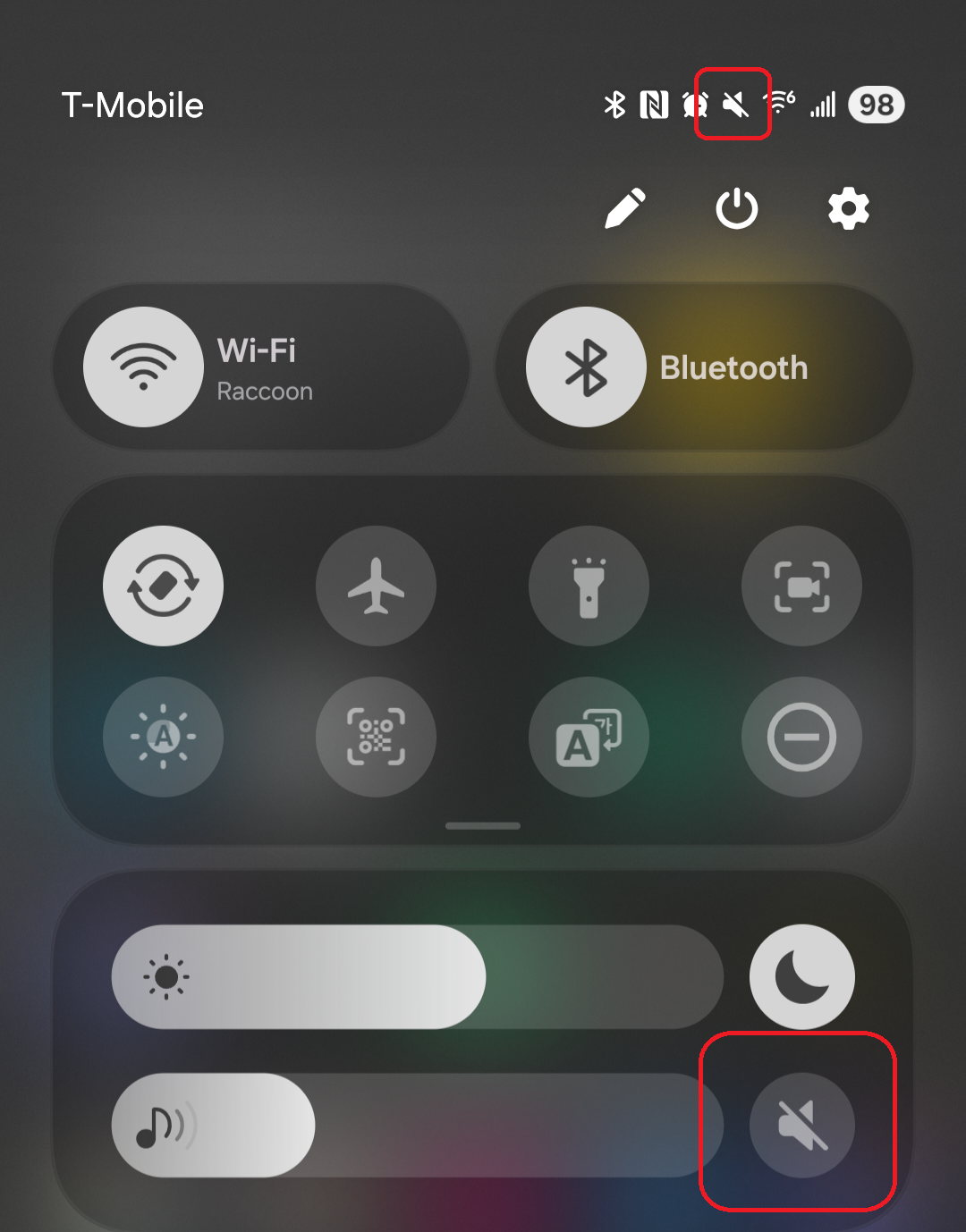
On Android phones, the volume bar indicates the current volume the phone is set at. However, the icon to the right indicates if the phone is set to a mode that gives no audio but does provide a vibration, or if the phone is completely silent as highlighted in two places in the screenshot above.
I am fairly confident this is the bug that almost led to me going into a coma yesterday morning. How that gets past quality assurance testing and then somehow gets approved by the Federal Drug Administration (FDA) is baffling. The fact I pointed out such bugs in the alarms four years ago via blog, Tweets, Twitter DMs, and multiple phone calls shows that Abbott has not listened to customer feedback, even when the bugs can be life threatening.
How am I typing this blog given all of the above? I got lucky.
I can guarantee you, without reservation or hesitation, Abbott’s technology had nothing to do with initially saving me yesterday morning. If I wasn’t using a CGM I would have had test strips next to the bed like I did before I used the CGM technology. I would have known my glucose reading from a test strip or the CGM equally. Because I trusted Abbott’s technology instead of traditional test strips, I may have put myself at greater risk. I directly blame the bugs in their software for not warning me when my glucose was trending down, throwing the alarm to wake me, and allowing me to correct it before it became that big of a risk. I was close to going into a coma yesterday morning and potentially dying, as a direct result of Abbott’s failing technology.
When I talk to support next week, I will finally be able to answer their question differently. “Did this lead to a serious medical emergency?“